Tarihin tsare-tsaren caca na roulette
Ƙarni biyu na mutane suna rubuta dokoki kan yadda za su canja kuɗin cacarsu.
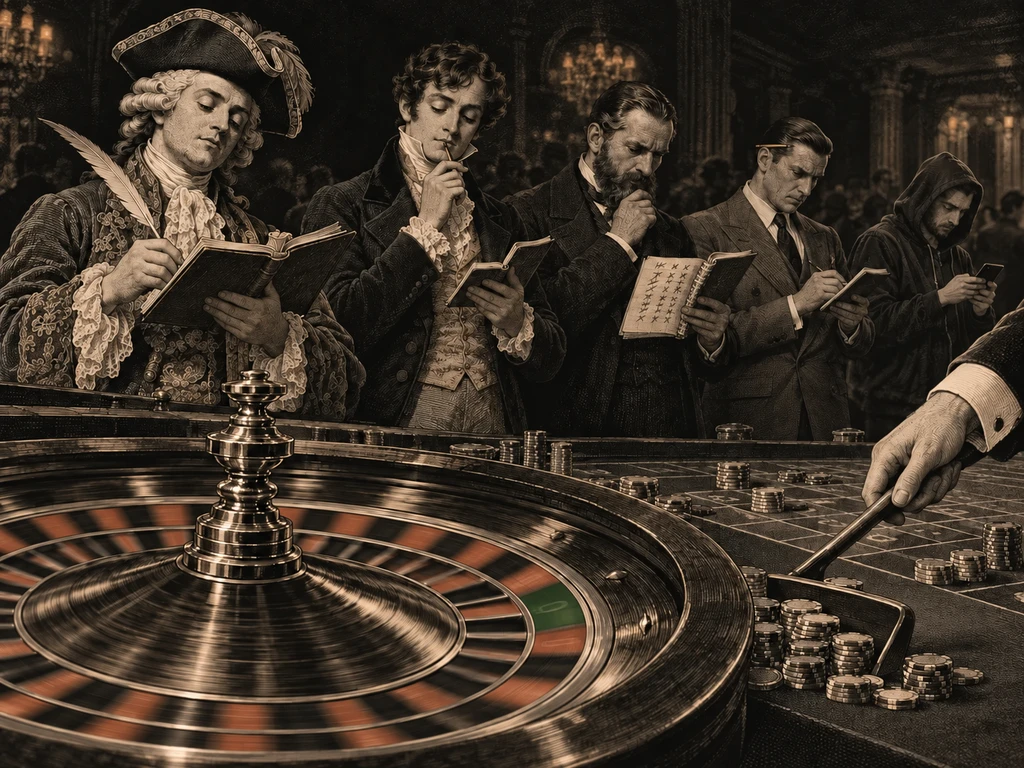
Martingale na ƙarni na 18 ne; D’Alembert an sanya masa sunan masanin lissafin da bai so shi ba; Labouchère abin sha'awar wani ɗan siyasa ne na zamanin Victoria. Babu ɗaya daga cikinsu da ya yi aiki a lokacin ma.
Martingale
The 1762 Académie française dictionary records martingaledabaraMartingaleJerin ƙarin caca da ke ninka caca bayan kowace asara. Ku duba sashen “Dabarun caca na roulette” don ganin abin da yake yi da wanda ba ya yi.Karanta gaba ɗaya → as a gambling term for staking what has been lost. Its 1878 edition explicitly describes doubling after a loss and also uses the word more broadly for betting schemes. These entries document usage; they do not identify a single inventor.
Today the familiar doubling progressiondabaraJerin ƙarin cacaDuk wata ƙa'ida da ke canza kuɗin caca bisa sakamakon da ya gabata. Jerin ƙarin caca bayan asara yana ɗaga shi bayan an rasa, na bayan nasara kuma bayan an ci.Karanta gaba ɗaya → aims to recover previous losses and gain one starting unitkuɗiRaka'aKuɗin caca na tushe da tsari ko ɗan wasa ke aiki da shi. Ana bayyana jerin ƙarin caca a raka'a don su yi aiki a kowane tebur.Karanta gaba ɗaya → when a win arrives. A finite bankrollkuɗiJarin cacaJimillar kuɗin da aka ware don wasa. Sarrafa jarin caca shi ne yanke shawarar nawa za a sa a haɗari a kowace caca da kowane zaman wasa.Karanta gaba ɗaya → or table limitteburIyakar teburiMafi ƙanƙanta da mafi girman cacar da aka yarda da ita. Mafi girman ita ce ke dakatar da jerin ƙarin caca masu ninkawa.Karanta gaba ɗaya → can stop the sequence first. The Strategy section shows how those limits affect a session.
D’Alembert
The progression bearing d’Alembert’s name raises the stake by one unit after a loss and lowers it after a win. The name alone does not prove who devised or endorsed the betting rule.
Its mathematical issue is straightforward: on independent spinslissafiJuye-juye masu zaman kansuKowane juyi yana da yiwuwa iri ɗaya komai abin da ya faru a baya. Tushen kowane lissafi a wannan shafin.Karanta gaba ɗaya →, a run of one outcome does not make the opposite outcome due. A famous namesake does not change that assumption or the payoutkuɗiBiyaAbin da cacar da ta ci ke dawowa da shi, ana faɗinsa a matsayin “X zuwa 1” a kan kuɗin cacar da aka mayar.Karanta gaba ɗaya →.
Labouchère
The cancellation system uses a list of numbers to determine the next stake. A win removes entries and a loss adds an entry; the Strategy section sets out the rules and examples. Historical stories about its namesake should be distinguished from evidence that the method creates an advantage.
A sequence may clear with a profit, but a losing run can leave a growing list and larger required stakes. How often it clears depends on the starting list, bankroll, limits and stopping rule. There is no universal success percentage.
Ƙarni na 20
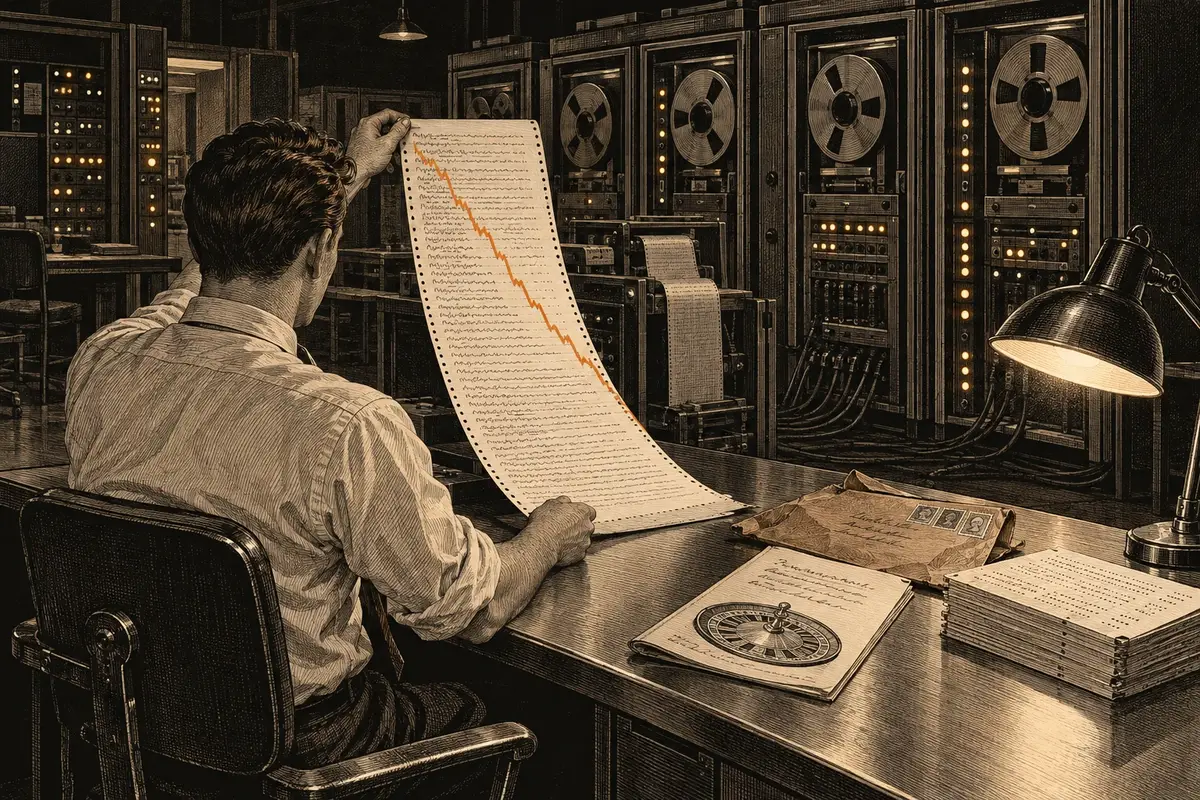
A simulation can show how a specified system behaves under a chosen wheel model. It cannot test every possible rule, and a finite run need not return exactly the theoretical house edgelissafiFifikon gidan cacaKason kowane kuɗin caca da gidan caca ke riƙewa a matsakaici: 2.70% a roulette na Turai.Karanta gaba ɗaya →.
For independent uniform single-zerodabaranSifiliRamin kore guda ɗaya da babu cacar ɗaya zuwa ɗaya, ta dozin ko ta ginshiƙi da ke rufe shi; tushen fifikon gidan caca. Ana kuma kiransa: sifili ɗaya, 0.Karanta gaba ɗaya → spins with standard full-loss-on-zero payouts, each unit staked has expected net return −1/37. For a bounded session whose stakes are chosen using information available before each spin, adding the conditional expectations gives expected losslissafiAsarar da ake tsammaniƘimar da ake tsammani sau jimillar kuɗin da aka yi caca da su; matsakaicin adadin da ake rasawa a cikin zaman wasa ko wani lokaci.Karanta gaba ɗaya → equal to 1/37 of expected turnoverkuɗiJimillar cacaJimillar kuɗin da aka yi caca da su a cikin zaman wasa ko wani lokaci, har da kuɗin da aka ci aka sake sawa. Ana kuma kiranta: handle, action.Karanta gaba ɗaya →. Stopping or changing stakes can change the distribution of results, but not create positive expectation under those assumptions. Other payouts, such as la partageƙa'idaLa partageƘa'idar Faransa: idan sifili ya fito, ana mayar da rabin kuɗin cacar ɗaya zuwa ɗaya (even-money). Tana rage fifikon gidan caca a kan waɗannan cace-cace da rabi, zuwa 1.35%.Karanta gaba ɗaya →, need their own calculation.
Tatsuniya: dabarar roulette da kullum take cin nasaraDabarar Fibonacci a roulette
Dalilin da ya sa suke ci gaba da wanzuwa
A demonstration can end in profit without showing that the method has an edge. Some rules favor frequent small wins at the cost of occasional large losses; others do the reverse. The proportions depend on the exact rules and limits.
When comparing systems, look at all completed sessions, total stakes, losses and stopping conditions. A selected winning example leaves out the information needed to assess the claim.
Tsare-tsaren da ake sayarwa
Systems have also been sold with elaborate names and entry rules. The examples below illustrate the arithmetic of specific rules; they are not evidence of who first invented or marketed them. Waiting for a pattern does not alter the next independent spin’s probabilities.
Wanda ba tsari ba ne
Dokokin tsayawa: yanke shawara tun da wuri kan yawan kuɗin da za a yi asara ko a ci, sannan a tafi. Ana yawan sayar da su a matsayin wani ɓangare na tsari, kuma su ne kawai ɓangaren da ke yin wani abu, domin suna rage jimillar caca. Ba a sanya musu sunan kowa ba, wanda ya dace.
Tambayoyi
Martingale, da ƙarni ɗaya ko fiye. Ninkawa bayan asara shi ne tunani na farko da kowa ke yi.
D’Alembert ne ya fi kusa, ba da gangan ba. Pascal, Fermat, Huygens, Bernoulli da Laplace duka sun bayyana dalilin da ya sa suke gazawa.
Domin yawancin zaman wasa suna ƙarewa da nasara, kuma bidiyon zaman wasa na nasara ba shi da tsada a yi.
Ɗan barkwanci
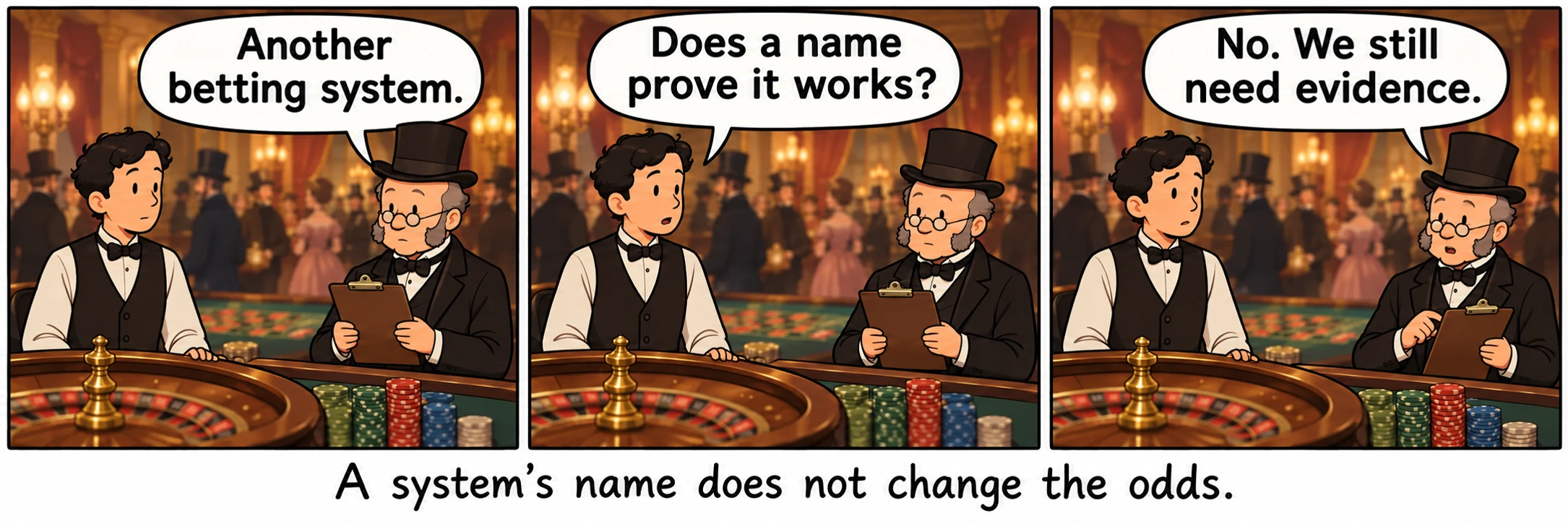
Ƙarni biyu na sunaye. Lamba ɗaya.
Majiyoyi
- Thorp, E. O. “Optimal gambling systems for favorable games.”
- Thorp, E. O. The Mathematics of Gambling.
- Doob, J. L. “Note on probability.”
- Halmos, P. R. “Invariants of certain stochastic transformations: the mathematical theory of gambling systems.”
- d’Alembert, J. “Croix ou pile.”
- Schwartz, D. G. Roll the Bones: The History of Gambling.
- Kavanagh, T. M. Dice, Cards, Wheels: A Different History of French Culture.
- Bollman, M. Mathematics of the Big Four Casino Table Games: Blackjack, Baccarat, Craps, & Roulette.
- Académie française, martingale, 1762
- Académie française, martingale, 1878